
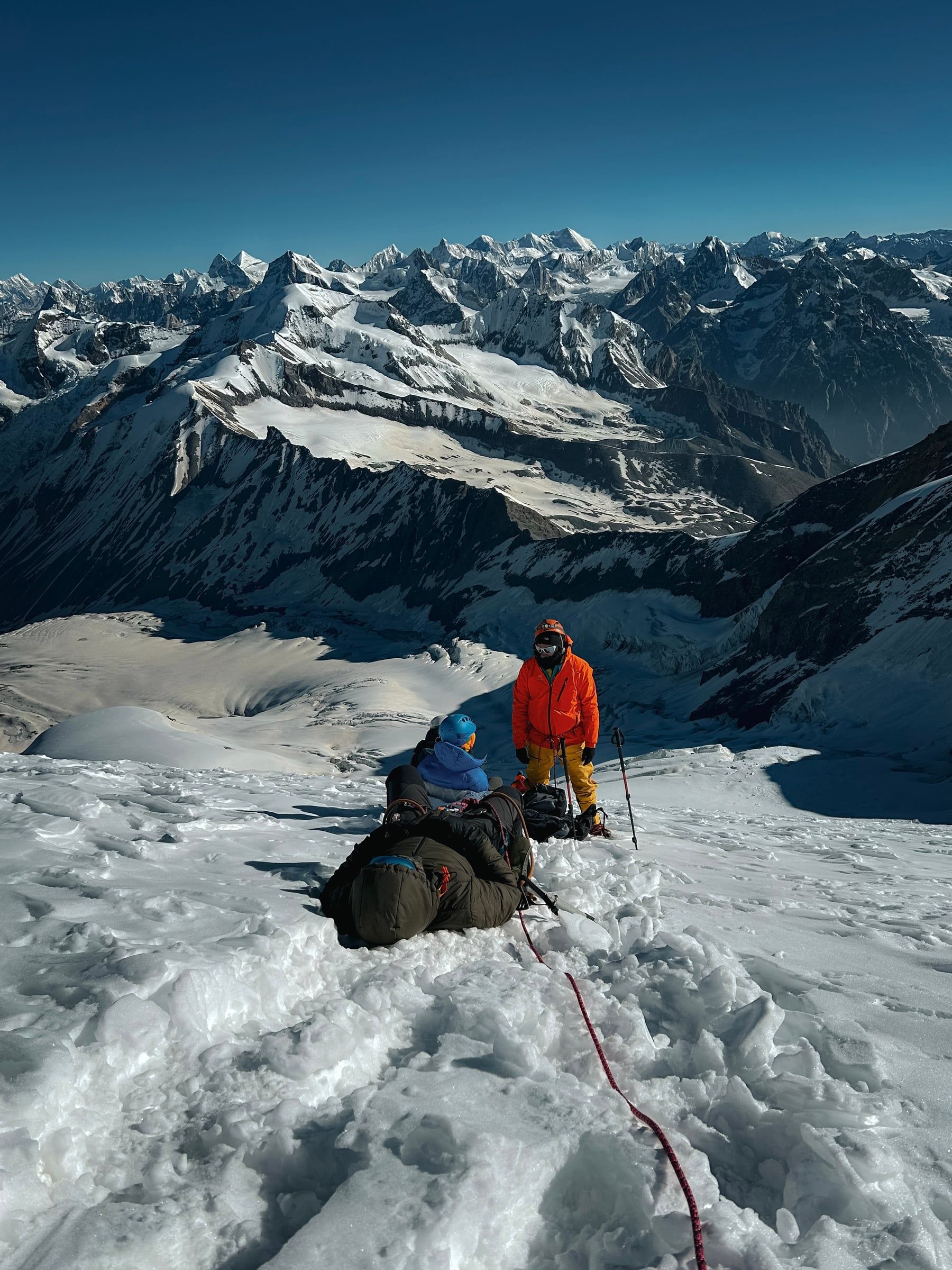
The fork.
Hold altitude.
Hydrate, treat the headache, keep exertion low, and reassess in 12-24 hours. Do not go higher while symptoms continue.
Stop ascending.
Do not climb higher. Descend if there is no improvement or if symptoms worsen.
Descend now.
Brain signs or lung signs change the decision. Descend, use oxygen if available, minimise exertion, and keep the person supervised.
Descent is the treatment that changes the mountain.
Oxygen and medicines can buy time. Descent reduces the altitude load. CDC notes that AMS improves with a descent of at least 300 m. WMS says AMS/HACE often improve after 300-1,000 m, while HAPE patients should try to descend at least 1,000 m or until symptoms resolve.
Do not leave the patient unattended; WMS explicitly calls for supervised descent or evacuation. Exert the person as little as possible while going down.
Oxygen helps, but it is not a plan by itself.
1-2 L/min can improve headache in about 30 minutes and resolve symptoms over hours, according to CDC.
Give oxygen and target SpO2 at least 90%, per WMS 2024.
With medical care and oxygen on hand, mild HAPE can sometimes be managed with oxygen plus bedrest for 2-4 days at the same altitude. Field default remains descent.
Medicines are adjuncts, not substitutes for descent.
These are published guideline doses, not personal instructions. In India, dexamethasone, nifedipine, and acetazolamide are prescription medicines.
Symptom relief can include ibuprofen 600 mg or paracetamol 500 mg every 8 hours for headache, and ondansetron 4 mg for nausea, as noted in CDC guidance. Talk to a doctor before the trip.
A pressure bag is a bridge.
A portable hyperbaric chamber, often called a Gamow-type bag, pressurises to about 2 psi. CDC describes that as mimicking roughly 1,500-1,800 m of descent, with a packed weight around 6.5 kg.
The closing rule.
If symptoms are worsening at altitude, the safe default is to stop ascending and descend.
Series sources
- Luks AM, Beidleman BA, Freer L, Grissom CK, Keyes LE, McIntosh SE, Rodway GW, Schoene RB, Zafren K, Hackett PH. Wilderness Medical Society Clinical Practice Guidelines for the Prevention, Diagnosis, and Treatment of Acute Altitude Illness: 2024 Update. Wilderness & Environmental Medicine, 2024. PMID 37833187.
- Roach RC, Hackett PH, Oelz O, Bärtsch P, Luks AM, MacInnis MJ, Baillie JK, et al. The 2018 Lake Louise Acute Mountain Sickness Score. High Altitude Medicine & Biology, 2018. PMC6191821.
- CDC Yellow Book. High-Altitude Travel and Altitude Illness. 2026 edition, updated April 23, 2025.
- Burtscher J, Swenson ER, Hackett PH, Millet GP, Burtscher M. Flying to high-altitude destinations: Is the risk of acute mountain sickness greater? Journal of Travel Medicine, 2023. PMC10289512.
- Severinghaus JW. Simple, accurate equations for human blood O2 dissociation computations. Journal of Applied Physiology, 1979.
- Ryan BJ, et al. AltitudeOmics: Rapid Hemoglobin Mass Alterations with Early Acclimatization to and De-Acclimatization from 5,260 m in Healthy Humans. PLoS ONE, 2014. PMC4182755.
This series is educational and is not a diagnosis, prescription, or substitute for medical care. Talk to a doctor before travelling to high altitude, especially if you have medical conditions or need medication planning.