
Editor’s picks
Three peaks for three climber profiles. The full 10-peak table is below.
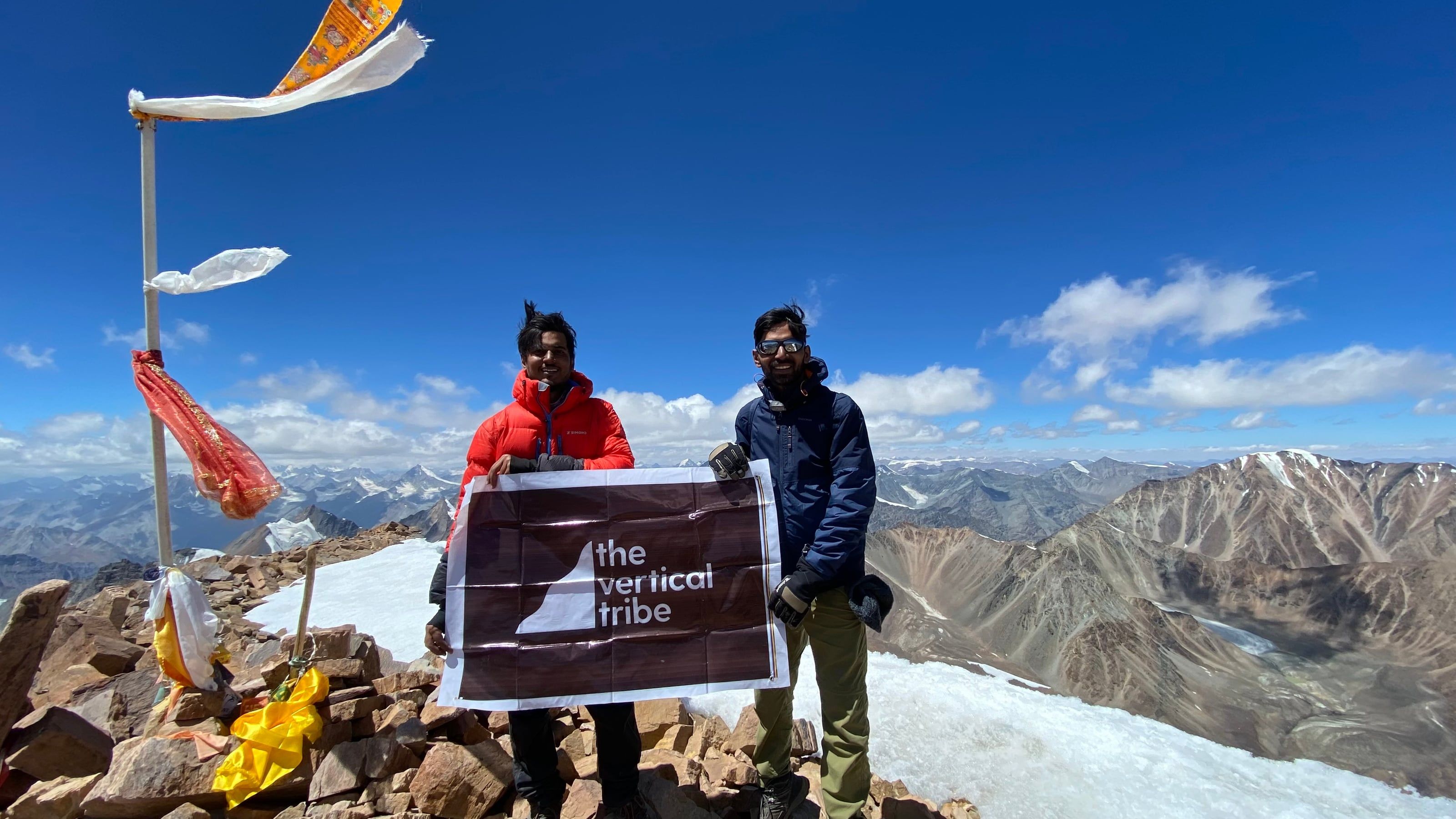
Yunam Peak
6,111m · Moderate (PD)PD · Peu DifficileA little difficult. Snow up to ~45°, possibly a short rock step. Rope on, but you're moving as a team behind a guide — not leading pitches. Most "first 6,000ers" sit here. Read the grading glossary → · Lahaul, Himachal Pradesh
Roadhead at 4,700m, no glacier, snow-walk summit day. The shortest, cheapest legitimate 6,000m summit certificate in the country.
8 days 3 nights ≥5K ₹55k–₹80k
Enquire about this peak →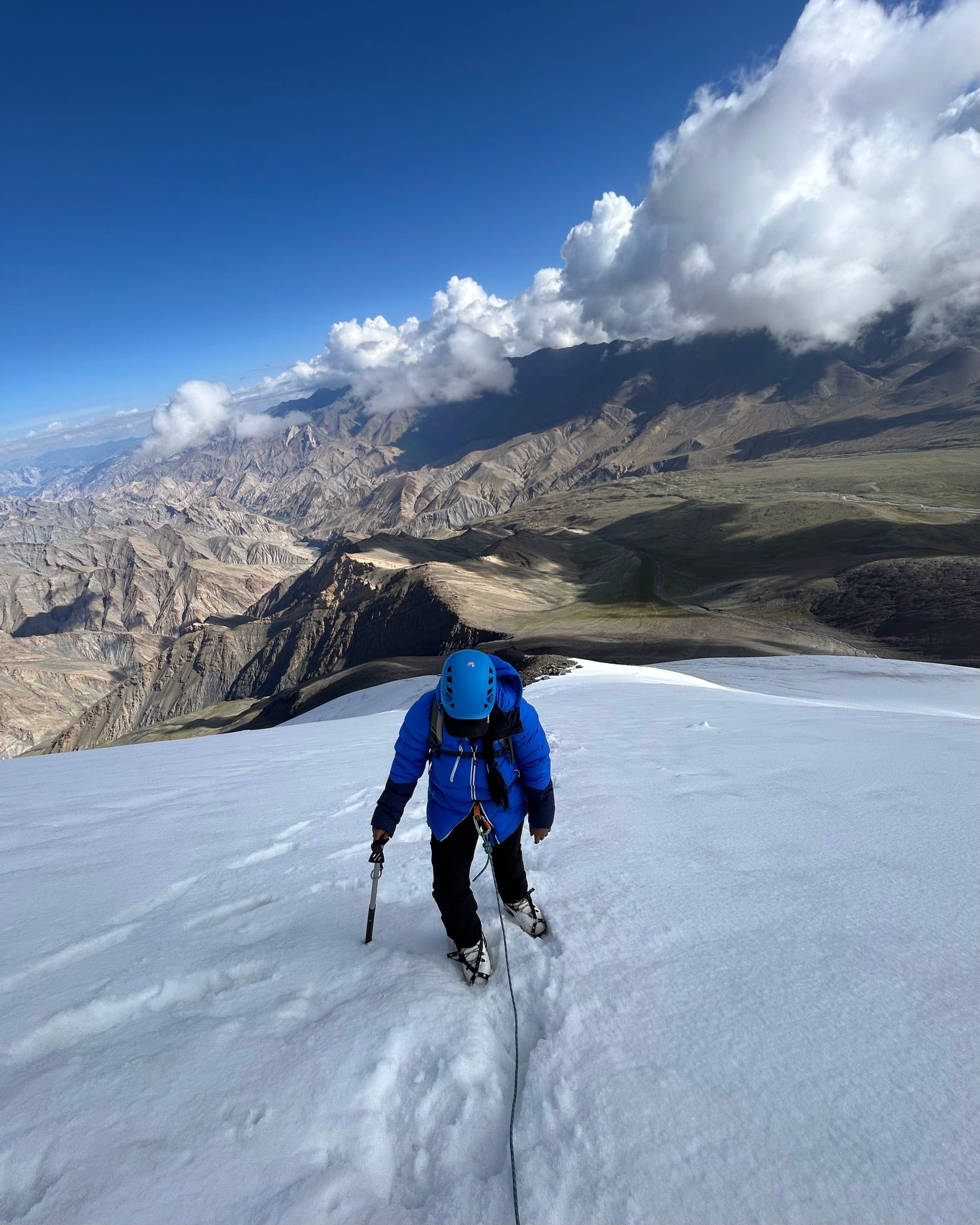
Kang Yatse II
6,250m · Moderate (PD+)PD+ · Peu DifficileHarder end of PD. Sustained snow with at least one real technical move — fixed lines on the headwall, summit slopes around 45° for several rope lengths. Kang Yatse II is the textbook example. Read the grading glossary → · Ladakh
Markha Valley trek doubles as acclimatization. Snow-slope summit, no fixed lines. The default first 6,000er for Indian climbers post-Stok-closure.
10 days 4 nights ≥5K ₹70k–₹110k
View itinerary →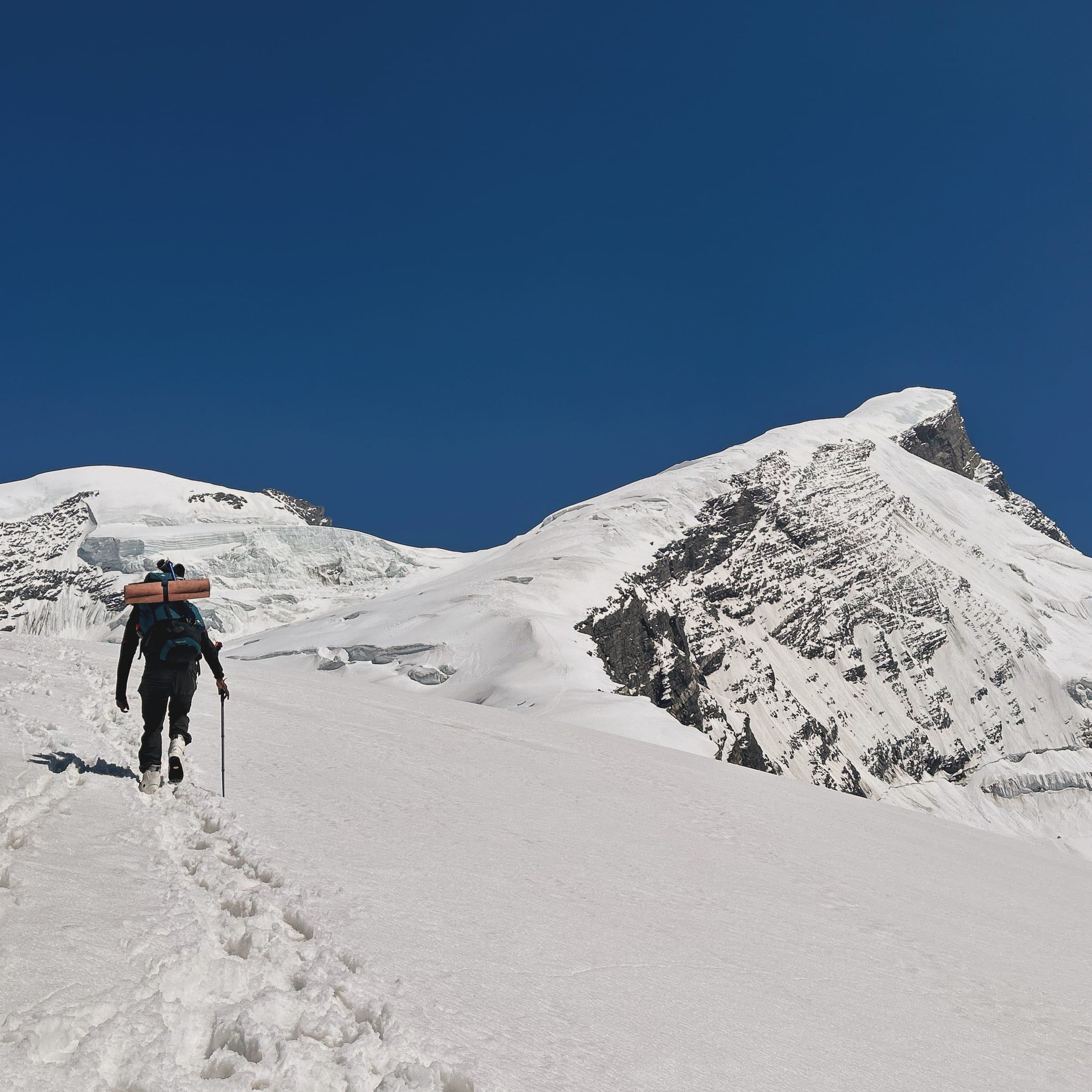
Black Peak
6,387m · Hard (AD-)AD- · Assez DifficileEasier end of "fairly hard". One genuinely steep technical pitch — typically a fixed-rope ice wall or short rock step at UIAA III. Black Peak's 70° ice wall sits here. Read the grading glossary → · Uttarakhand
A real expedition with a 70° ice wall on summit day. Built for fit BMC graduates who want a serious AD- objective from a Garhwal base.
15 days 5 nights ≥5K ₹80k–₹120k
View itinerary →All 10 candidates · compared
Sorted by altitude within each region. Source: peak-data v1 · CC-BY-4.0.
Ladakh 5 peaks
| Peak | Altitude | Grade | Season | Days | Cost (INR) | Operator |
|---|---|---|---|---|---|---|
| UT Kangri Stok Range | 6,070m | PDPD · Peu DifficileA little difficult. Snow up to ~45°, possibly a short rock step. Rope on, but you're moving as a team behind a guide — not leading pitches. Most "first 6,000ers" sit here. Read the grading glossary → | July, August+ | 9 | ₹60k–₹95k | Enquire → |
| Dzo Jongo East aka Dzo Jongo (E) Zanskar Range (Markha-Hemis sector, Nimaling) | 6,217m | PDPD · Peu DifficileA little difficult. Snow up to ~45°, possibly a short rock step. Rope on, but you're moving as a team behind a guide — not leading pitches. Most "first 6,000ers" sit here. Read the grading glossary → | July, August+ | 10 | ₹70k–₹110k | Itinerary → |
| Kang Yatse II aka Kang Yatse 2 Zanskar Range (Markha-Hemis sector) | 6,250m | PD+PD+ · Peu DifficileHarder end of PD. Sustained snow with at least one real technical move — fixed lines on the headwall, summit slopes around 45° for several rope lengths. Kang Yatse II is the textbook example. Read the grading glossary → | July, August+ | 10 | ₹70k–₹110k | Itinerary → |
| Mentok Kangri II aka Mentok II Mentok Range | 6,250m | PDPD · Peu DifficileA little difficult. Snow up to ~45°, possibly a short rock step. Rope on, but you're moving as a team behind a guide — not leading pitches. Most "first 6,000ers" sit here. Read the grading glossary → | July, August+ | 10 | ₹80k–₹120k | Enquire → |
| Mentok Kangri I aka Mentok I Mentok Range | 6,277m | PD+PD+ · Peu DifficileHarder end of PD. Sustained snow with at least one real technical move — fixed lines on the headwall, summit slopes around 45° for several rope lengths. Kang Yatse II is the textbook example. Read the grading glossary → | July, August+ | 11 | ₹85k–₹130k | Enquire → |
Himachal Pradesh 4 peaks
| Peak | Altitude | Grade | Season | Days | Cost (INR) | Operator |
|---|---|---|---|---|---|---|
| Deo Tibba Pir Panjal | 6,001m | PD+PD+ · Peu DifficileHarder end of PD. Sustained snow with at least one real technical move — fixed lines on the headwall, summit slopes around 45° for several rope lengths. Kang Yatse II is the textbook example. Read the grading glossary → | May, June+ | 11 | ₹70k–₹110k | Enquire → |
| CB-14 aka Chandra Bhaga 14 Lahaul (Chandra-Bhaga group) | 6,078m | PDPD · Peu DifficileA little difficult. Snow up to ~45°, possibly a short rock step. Rope on, but you're moving as a team behind a guide — not leading pitches. Most "first 6,000ers" sit here. Read the grading glossary → | June, July+ | 13 | ₹85k–₹130k | Enquire → |
| Yunam Peak aka Mt Yunam Great Himalayan Range | 6,111m | PDPD · Peu DifficileA little difficult. Snow up to ~45°, possibly a short rock step. Rope on, but you're moving as a team behind a guide — not leading pitches. Most "first 6,000ers" sit here. Read the grading glossary → | June, July+ | 8 | ₹55k–₹80k | Enquire → |
| CB-13 aka Chandra Bhaga 13 Lahaul (Chandra-Bhaga group) | 6,264m | PD+PD+ · Peu DifficileHarder end of PD. Sustained snow with at least one real technical move — fixed lines on the headwall, summit slopes around 45° for several rope lengths. Kang Yatse II is the textbook example. Read the grading glossary → | June, July+ | 14 | ₹90k–₹140k | Enquire → |
Uttarakhand 1 peak
| Peak | Altitude | Grade | Season | Days | Cost (INR) | Operator |
|---|---|---|---|---|---|---|
| Black Peak aka Kalanag Bandarpunch Massif | 6,387m | AD-AD- · Assez DifficileEasier end of "fairly hard". One genuinely steep technical pitch — typically a fixed-rope ice wall or short rock step at UIAA III. Black Peak's 70° ice wall sits here. Read the grading glossary → | May, June+ | 15 | ₹80k–₹120k | Itinerary → |
Frequently asked
What is the easiest 6,000m peak to climb in India?
Yunam Peak (6,111m) on the Manali–Leh highway. The roadhead at Bharatpur means base camp is reached in hours instead of days, and the standard route is graded PD — a snow walk only, with no rock or fixed lines. An eight-day trip costs roughly ₹55,000–₹80,000 plus the IMF royalty of US$500 per party of two (any peak below 6,500m, per the live IMF peak-fee schedule).
Is Stok Kangri still open for climbing?
No. Stok Kangri (6,153m) was closed by the Ladakh Wildlife Department in 2020 for ecological recovery and remains closed as of 2026. The closest like-for-like alternatives are Kang Yatse II, Dzo Jongo East, and Mentok Kangri II — all in the same Ladakh region, all open under IMF rules, all comparable in altitude and grade.
What is the best first 6,000m peak in India for a BMC graduate?
Three peaks suit different climber profiles. Yunam Peak (6,111m) for the lowest technical bar. Kang Yatse II (6,250m) for the climber who wants a Markha Valley trek built into the acclimatization. Black Peak / Kalanag (6,387m) for the fit BMC graduate who wants a real AD- objective with a single steep ice wall. All three are open peaks under IMF rules with established operator pipelines.
How much does a 6,000m peak in India cost?
Operator fees for a guided 12–15 day Indian 6,000m expedition run ₹70,000 to ₹1,20,000 in 2026 pricing. Total all-in cost — operator fee plus IMF royalty share, gear, travel and insurance — typically lands at ₹95,000 to ₹1,60,000 for an Indian climber. The live IMF peak-fee schedule does not list a separate Indian-led / foreign-led tier; foreign nationals pay the same royalty but add the US$500 Liaison Officer kit fee, the LO's day rate, and operator paperwork surcharges, taking total costs to roughly US$3,500–5,000.
Do I need IMF clearance to climb a 6,000m peak in India?
Yes. Every climbing peak above 6,000m on the IMF list requires an expedition application to the Indian Mountaineering Foundation and payment of the peak royalty. The live IMF schedule (indmount.org/IMF/peakfee) charges US$500 (party of two) for any peak below 6,500m, US$700 for 6,501–7,000m, and US$1,000 for 7,001m and above, plus a US$500 Liaison Officer kit-hire fee. A refundable environmental/garbage deposit applies but the figure is not currently posted publicly. Guided operators handle the paperwork; self-led teams must apply directly and meet IMF experience criteria.
When is the best time to climb a 6,000m peak in India?
Three windows: late May to mid-June (pre-monsoon) and mid-September to mid-October (post-monsoon) for Garhwal and Pir Panjal peaks (Black Peak, Deo Tibba, Friendship Peak); July to September for the Ladakh peaks (Kang Yatse, Dzo Jongo, Mentok, Yunam). Operator slots fill earliest for Black Peak, Kang Yatse II and Friendship Peak — book 4–6 months ahead.
Not ready for a 6,000er yet?
Four sub-6,000m peaks that build the same skills at lower altitude, lower cost and shorter commitment. Friendship Peak alone draws roughly 3,600 searches a month in India — it remains the most popular climbing peak in the country.
Shitidhar
Friendship Peak's neighbour. Identical access, identical skills, slightly easier summit day. Almost always done as a duo with Friendship.
7 days ₹35k–₹60k from Solang Nala
Friendship Peak
The most-searched climbing-peak keyword in Indian Google data. Sub-6,000m but covers most of the same skills. Often paired with Shitidhar in an 8-day window from Manali. Indian Army made the first winter ascent in January 2015.
8 days ₹40k–₹65k from Solang Nala
Rudugaira
A friendly climbing peak in the Gangotri sector — the Garhwal answer to Friendship Peak. Often used by NIM Uttarkashi as a graduation climb.
9 days ₹55k–₹85k from Gangotri
Kanamo Peak
The classic 'almost 6,000er' walk-up from Kibber village. Non-technical, no glacier, one long summit day. Best entry point to Indian high-altitude climbing for a fit BMC graduate not yet ready for an ice wall. Climbed as a trekking peak; not on the IMF open list.
8 days ₹40k–₹65k from Kibber (Spiti)
Go deeper
Post-BMC decision guide
Long-form, ~3,000 words. Skill checklist, decision matrix, fitness benchmarks, 9–12 month roadmap.
Peak Match tool
Six questions, ranked matches in your browser. Filters by experience, days, budget, region, comfort and season.
Open dataset
The raw JSON behind every page on this site. CC-BY-4.0. Use it, cite it, build on it.