
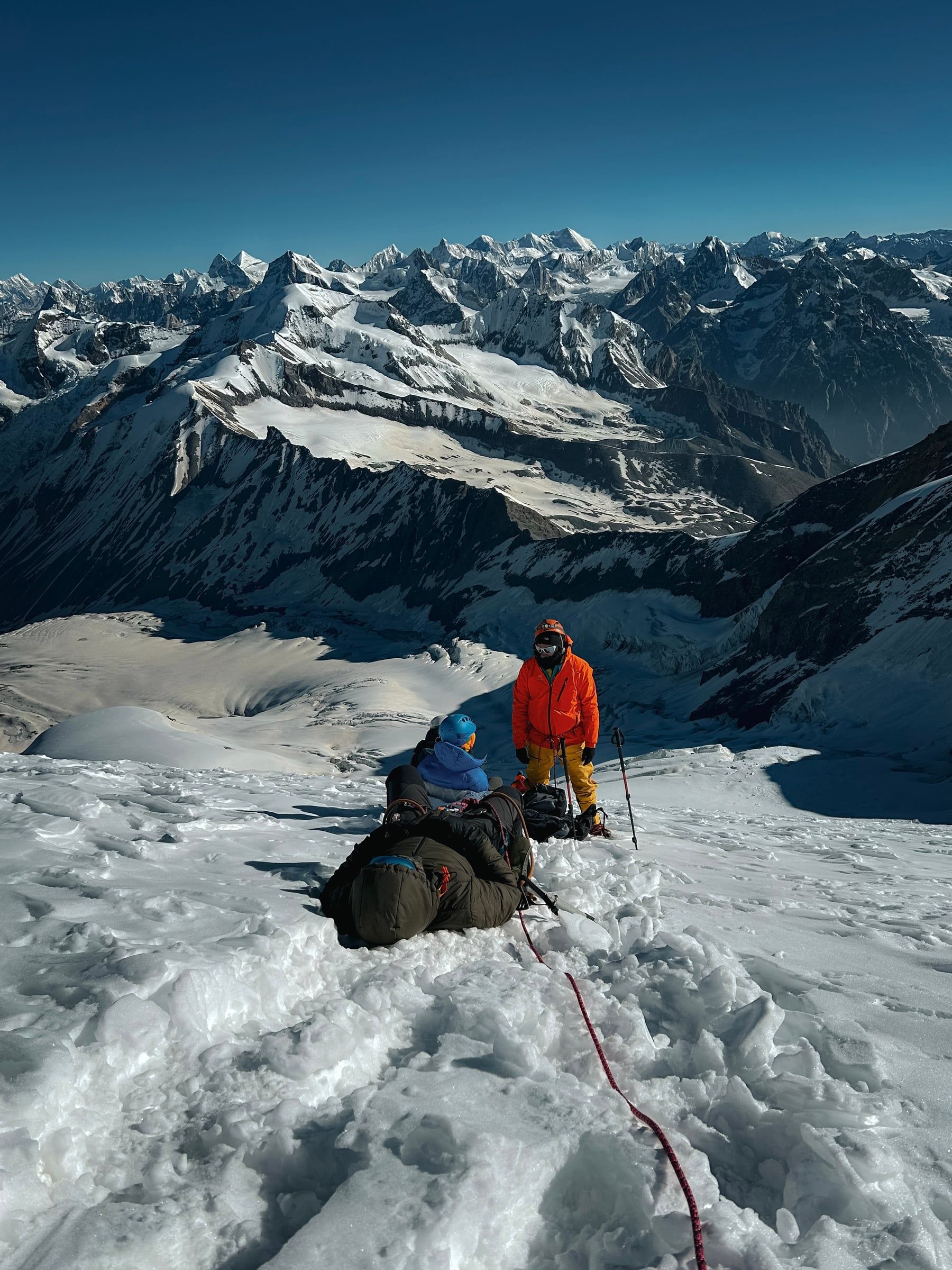
AMS is the common, recoverable form.
The cardinal symptom is headache, plus at least one of appetite loss, nausea, fatigue, weakness, dizziness, or light-headedness. If symptoms start more than 3 days after arrival without further ascent, the CDC warns against simply blaming AMS.
Do not score the moment you step off the plane or roadhead.
Lake Louise 2018 says to assess at least 6 hours after arrival.
Symptoms often show during or after the first night.
AMS usually eases if you stop ascending further.
The Lake Louise tap-scorer.
Score each item from 0 to 3. This page says "matches AMS" because a field score is not a medical diagnosis.
The 2018 update removed the old disturbed-sleep item. Poor sleep at altitude tracks hypoxia, but it is not part of the current AMS score.
The two red branches.
AMS is common and usually recoverable. HACE and HAPE are different: one is the brain, one is the lungs, and both change the field decision.
The common trunk
Headache after ascent plus appetite loss, nausea, fatigue, weakness, or dizziness. Hold altitude and reassess; do not keep climbing through it.
Confusion or ataxia
CDC describes HACE as end-stage AMS: altered mental status, ataxia, confusion, drowsiness, and behaviour that can look like alcohol intoxication.
Companion test: heel-to-toe walking. Stumbling or stepping off is the clearest field sign.
Breathless at rest
Early HAPE can look like cough, chest congestion, exertional breathlessness, and falling performance. Later: breathless at rest, wet cough, crackles, and sometimes pink sputum.
The mechanism
Uneven hypoxic pulmonary vasoconstriction raises pressure in parts of the lung circulation. Capillary stress failure lets fluid leak into the air spaces.
HAPE can occur without AMS. Do not wait for a headache before taking lung symptoms seriously.
Some signs mean stop now.
A Lake Louise score can tell you whether the common symptom pattern matches AMS. It does not replace a companion's judgement when someone is confused, cannot walk straight, or is breathless at rest. Part 4 is the treatment and descent line.
Sources
- Roach RC, Hackett PH, Oelz O, et al. The 2018 Lake Louise Acute Mountain Sickness Score. High Altitude Medicine & Biology, 2018. PMC6191821.
- CDC Yellow Book. High-Altitude Travel and Altitude Illness. 2026 edition, updated April 23, 2025.
- Luks AM, et al. Wilderness Medical Society Clinical Practice Guidelines for the Prevention, Diagnosis, and Treatment of Acute Altitude Illness: 2024 Update. Wilderness & Environmental Medicine, 2024. PMID 37833187.
Educational only, not medical advice. If symptoms worsen at altitude, the safe default is to stop ascending and descend.