
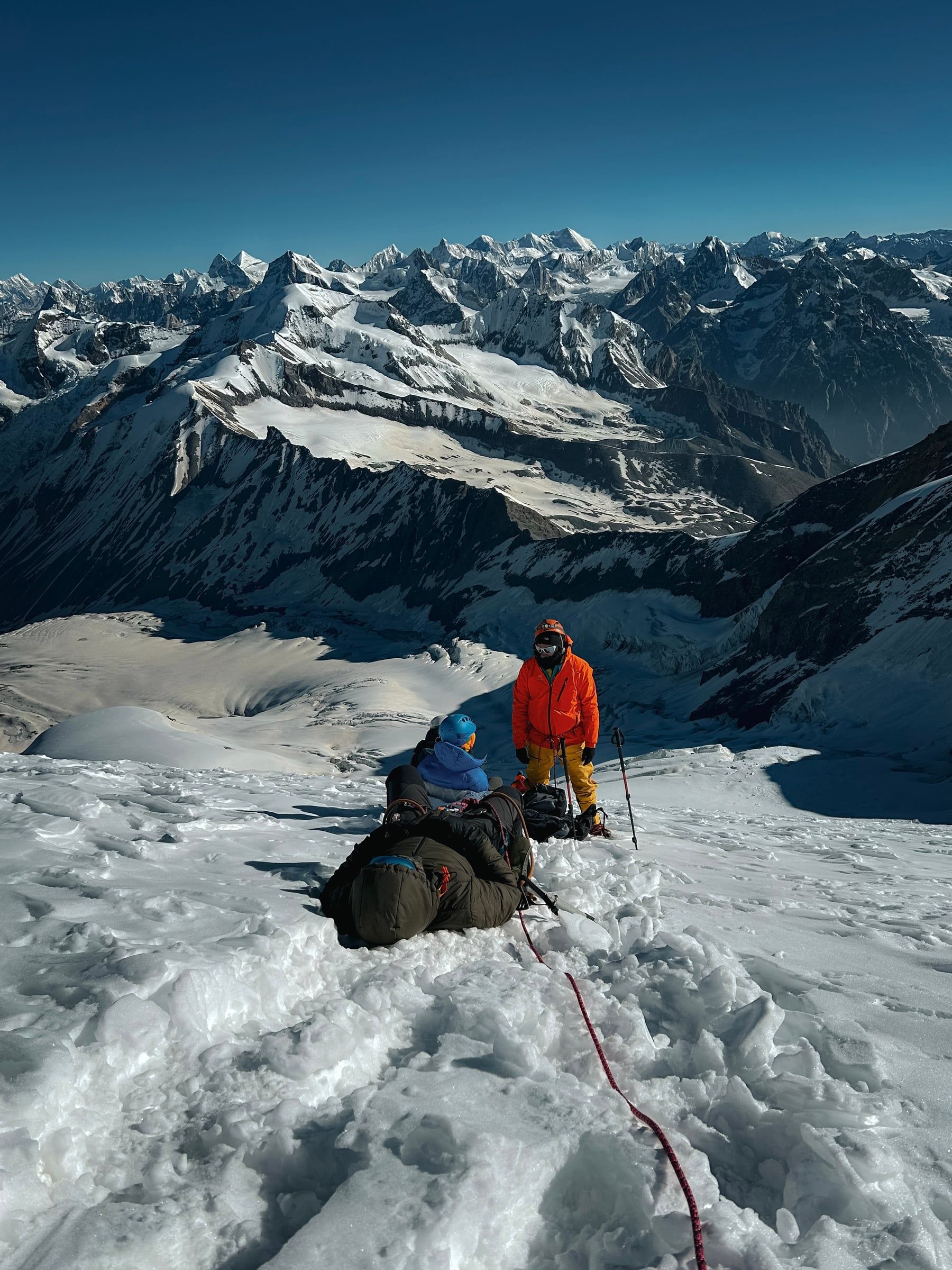
This is the cliff. Above ~2,500 m the curve turns down.
The air does not change.
Air at the summit of Everest is still 20.9% oxygen, the same as the air on a beach. Nothing is missing from it.
The pressure does.
What thins as you climb is the pressure pushing that oxygen across your lungs and into your blood. Watch the pressure bar empty as you rise.
For a while, your blood holds.
Blood oxygen barely moves through the foothills. The curve runs flat. This is why the first 2,000 m feel like nothing.
Then it falls off a cliff.
Past about 2,500 m the curve turns down hard. At Leh, 3,524 m, an unacclimatised arrival reads around 90%. A few nights claw some of it back, which is why a good Leh plan holds two nights before going higher.
At the top, the model stops being a trek prediction.
On the summit of Everest, this simple unacclimatised model falls toward 20%. Treat that as a stress-test number, not a real itinerary prediction.2 Climbers reach that zone only after staged acclimatisation, and often with bottled oxygen.
Your blood at Leh, 3,524 m, unacclimatised on day one: about 90%.
A reading like this is expected while you acclimatise. A low number on its own is not altitude sickness. Part 3 handles the symptom self-check.
| Altitude | Air pressure | O₂ to lungs | Blood O₂ |
|---|---|---|---|
| Sea level 0 m | 760 mmHg | 149 mmHg | 97% |
| Lohajung 2,300 m | 574 mmHg | 110 mmHg | 94% |
| Leh 3,524 m | 492 mmHg | 93 mmHg | 90% |
| Roopkund 5,029 m | 404 mmHg | 75 mmHg | 80% |
| Everest Base Camp 5,364 m | 386 mmHg | 71 mmHg | 77% |
| Yunam 6,111 m | 349 mmHg | 63 mmHg | 68% |
| Everest summit 8,848 m | 236 mmHg | 40 mmHg | 21% |
Your body does not take this lying down.
A few nights at altitude claw some oxygen back, which is why a good Leh itinerary holds two nights before going higher. The next part is about that fight: breathing, kidneys, blood chemistry, and the red-cell clock.
Sources
- Burtscher J, Swenson ER, Hackett PH, Millet GP, Burtscher M. Flying to high-altitude destinations: Is the risk of acute mountain sickness greater? Journal of Travel Medicine, 2023. PMC10289512.
- Severinghaus JW. Simple, accurate equations for human blood O₂ dissociation computations. J Appl Physiol, 1979. International Standard Atmosphere used for pressure–altitude.
This guide is educational and is not a diagnosis or a substitute for a doctor. If symptoms are worsening at altitude, the safe default is to stop ascending and descend.