
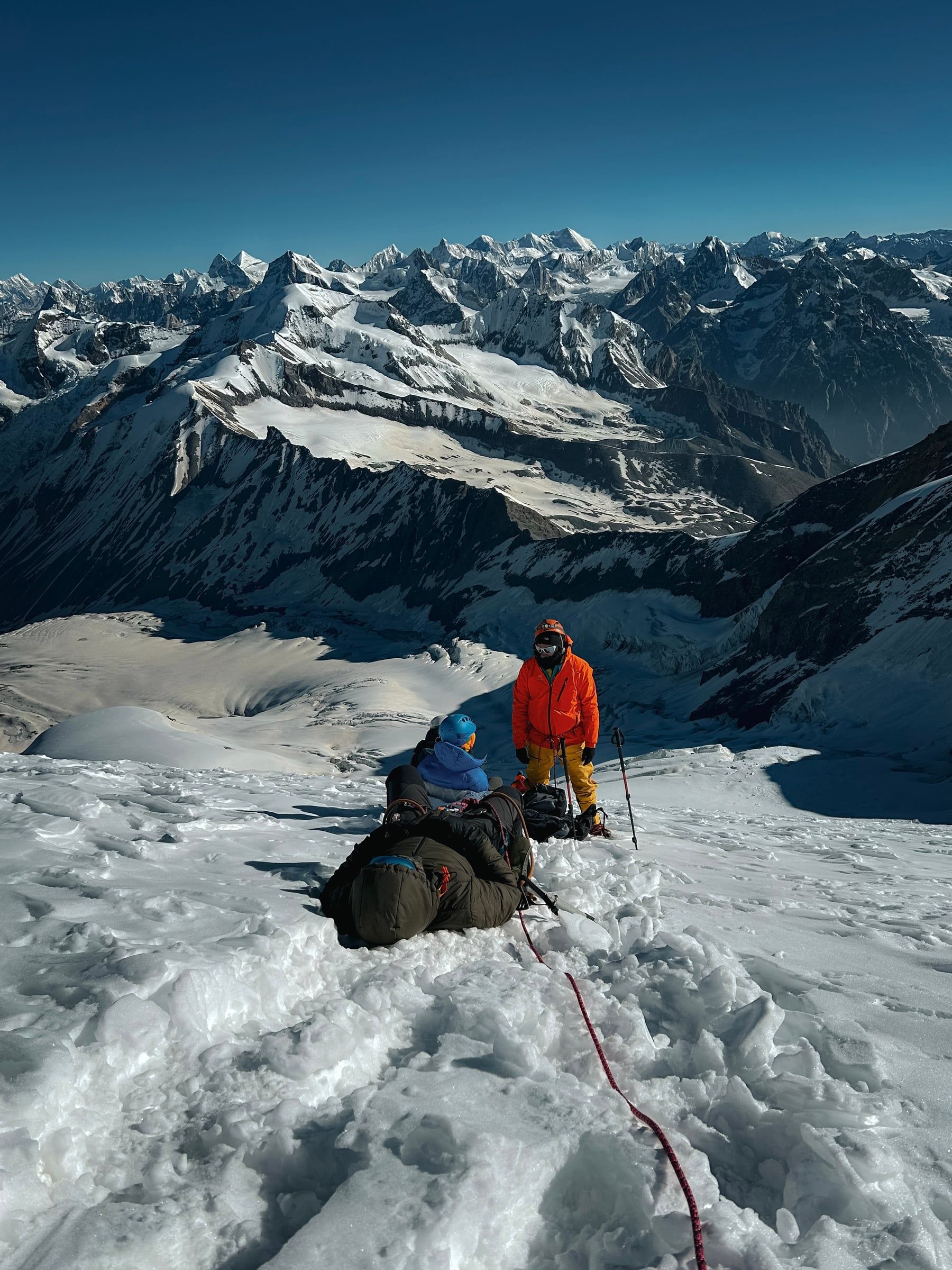
Three signals. Three responses.
Find which phase applies to you. Each is more urgent than the one before it.
- Notice Acute mountain sickness
Headache after ascent, plus nausea, appetite loss, fatigue, weakness, dizziness, or poor sleep.
Symptoms typically appear the first night at a new altitude. A low SpO2 reading alone is not the diagnosis.
Don't gain more altitude today. - Hold Symptoms persist or worsen
Symptoms not improving after 24 hours, or getting worse at the same altitude.
Ascending now makes it worse. If no improvement after 24 hours, descend 300–500 m.
Rest here. Don't ascend further. - Descend HACE or HAPE signs
Confusion, inability to walk straight, breathlessness at rest, or wet cough.
These are HACE (brain) or HAPE (lungs) signs — both medical emergencies. Do not wait for morning.
Descend now. Every metre matters.
The altitude illness series
- See what altitude does to your blood
Pressure falls, oxygen transfer falls, and the blood oxygen curve turns down past about 2,500 m.
- How your body fights back
The four clocks of acclimatisation: breathing, kidneys, oxygen unloading, and red-cell production — and where Diamox fits.
- How to tell if you have it
AMS symptoms, the Lake Louise self-check, and the red-flag branches into HACE and HAPE.
- When to turn around
The line between holding altitude, descending, oxygen, Diamox, and evacuation.
Glossary
- Altitude sickness noun
- Umbrella term for illness caused by reduced oxygen after rapid ascent to high altitude. Encompasses AMS, HACE, and HAPE.
- AMS abbr. · acute mountain sickness
- The common form of altitude illness. Headache after ascent, plus one or more of: nausea, fatigue, dizziness, or poor sleep. Recoverable with rest at the same altitude.
- HACE abbr. · high-altitude cerebral oedema
- Severe AMS with brain involvement. Warning signs: confusion, disorientation, and inability to walk straight (ataxia). A descent emergency.
- HAPE abbr. · high-altitude pulmonary oedema
- Fluid in the lungs at altitude. Warning signs: breathlessness at rest, wet cough, falling performance. Can occur without prior AMS. A descent emergency.
Common trekker questions
What are the first symptoms of altitude sickness?
The common acute mountain sickness pattern is headache after ascent, plus appetite loss, nausea, fatigue, weakness, dizziness, or light-headedness. Symptoms often appear after the first night at a new altitude.
How do you prevent altitude sickness on a trek?
The main prevention is a slower ascent: avoid large first-day jumps, keep sleeping-altitude gains conservative above 3,000 m, add rest days, hydrate normally, avoid overexertion, and discuss acetazolamide or Diamox with a doctor if your itinerary is aggressive.
Is Diamox a cure for altitude sickness?
No. Diamox, or acetazolamide, can help acclimatisation and is used in guideline-based prevention and treatment, but worsening altitude illness still requires stopping ascent and often descending. It is a prescription medicine in India.
When should you descend for altitude sickness?
Descend if symptoms worsen, if moderate AMS does not improve, or if there are HACE or HAPE warning signs such as confusion, inability to walk straight, breathlessness at rest, wet cough, or severe weakness.
Educational guide, not medical advice. Written against the CDC Yellow Book high-altitude travel chapter, Wilderness Medical Society 2024 altitude illness guidelines, and the 2018 Lake Louise AMS score. Consult a doctor before high-altitude travel, especially if you have medical conditions or need medication planning.