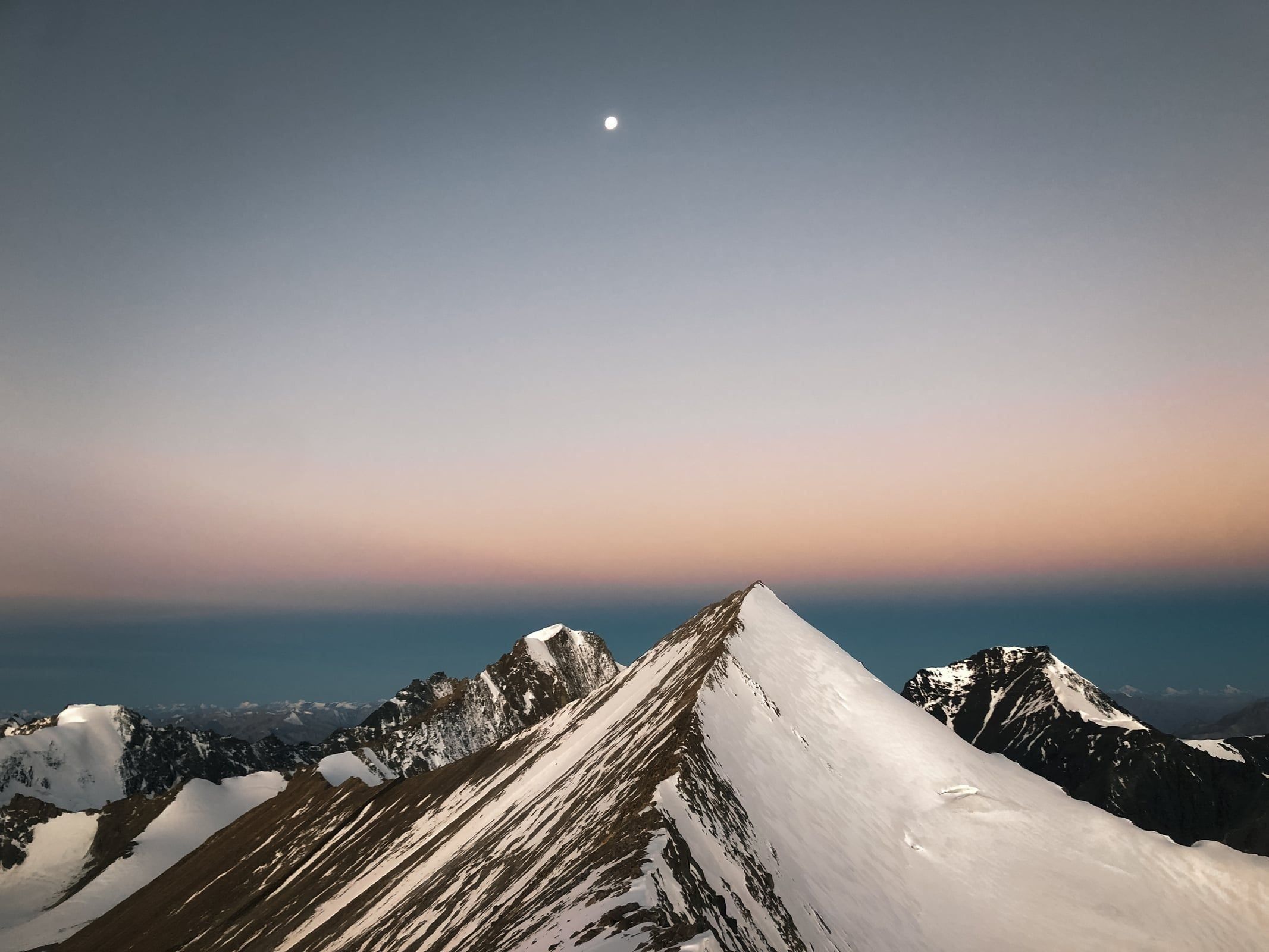
Dzo Jongo (E) Peak

A quieter, non-technical 6,000er in the Markha Valley · Ladakh

Duration
10 Days
Grade
Moderate (PD)PD · Peu DifficileA little difficult. Snow up to ~45°, possibly a short rock step. Rope on, but you're moving as a team behind a guide — not leading pitches. Most "first 6,000ers" sit here. Read the grading glossary →
Max altitude
6,217m
Best season
Jul–Sep
Start / end
Leh → Leh

Highlights

  • It's a non-technical 6,000er.
  • The quieter peak on the Kang Yatse approach.
  • The Markha approach is the trek of a lifetime.

Overview

Dzo Jongo East is climbed off the standard Markha Valley approach. Two nights in Leh to acclimatise, then a drive to the road head and the walk into the valley. Trail days carry you through Markha — the largest village in the valley — and Hankar, the last village before the high meadows, and up onto the high pasture toward the Nimaling area, where base camp sits at roughly 4,800m. A full rest-and-training day at base camp covers crampon fit, ice-axe self-arrest, and rope-team basics for glacier travel. Summit day is a pre-dawn alpine start: walk up the moraine, onto the broad snow slope above, and follow the line non-technically — crampons and ice axe, no fixed ropes — to a wide summit ridge with views across the Zanskar Range. Descent is back to base camp by midday. The exit crosses Kongmaru La (5,200m), the highest pass in the Markha Valley, drops to the Chokdo road head, and drives back to Leh. A buffer day is held back at the end for weather, a re-attempt, or a delayed flight in or out of Leh.

Who climbs with us

Dzo Jongo is one of our gentler 6,000ers — a non-technical snow walk to a wide summit ridge in the Markha Valley. Recent climbers have included first-time expeditioners using Dzo Jongo as their first 6,000m peak, and people pairing it with Kang Yatse II for a two-summit Ladakh trip. The base-camp acclimatisation and the non-technical line make it work for climbers who are trek-fit but new to snow.

What's included

Included

  • Transport — Leh to last road head and Chokdo to Leh
  • Accommodation — stay from Day 1 to last day in Leh (sharing)
  • Food — all meals from Day 3 lunch to lunch on the last day
  • Permits — all trekking permits and camping charges
  • Trekking and safety equipment — tents, sleeping bags, and technical equipment
  • Certified trek leaders, guides, and support staff

Not included

  • Backpack offloading charges
  • Any kind of personal insurance and rescue expenses
  • Meals during Leh stay and road journey
  • Personal expenses of any kind, and anything apart from the inclusions
  • Emergency evacuation and hospital charges

Dates & availability

No fixed dates yet — get in touch for the next Jul–Sep batch or private/custom dates.

We haven't opened a public batch for this expedition yet. Reach out and we'll share the next departure as soon as it's confirmed, or set up a private group on dates that suit you.

Need different dates? Private departures are possible through Jul–Sep with a minimum of 4 climbers — message us on WhatsApp.

Your guides

Subodh Bhadauriya

Subodh Bhadauriya ITRA

Lead Expedition Guide · 8+ years

Long-distance hiker, trail runner, and occasional poet — at home in the Himalaya.

Ajay Rawat

Ajay Rawat

Technical Climbing Specialist · 5+ years

A nomad from the greater Himalayas — happiest out walking.

Frequently asked

What is the Dzo Jongo East expedition?

Dzo Jongo East is a 6,217m guided summit climb in Ladakh's Markha-Hemis sector, run by The Vertical Tribe as a 10-day Leh-to-Leh expedition. It uses the classic Markha Valley approach — two acclimatisation nights in Leh, a walk-in via Markha and Hankar villages, base camp in the Nimaling area, a rest-and-training day, a non-technical snow-and-moraine summit climb, and a Kongmaru La crossing on the way out to Chokdo.

How difficult is Dzo Jongo East?

Alpine PD — non-technical. The standard route is essentially a walk-up: moraine, a long snow ridge, and a short rocky section to the top. You'll wear crampons on snow and carry an ice axe for self-arrest, but there are no fixed ropes and no crevassed glacier travel on the East summit. No prior mountaineering experience required. You should have completed at least one Himalayan trek above 4,500m and be able to run 5 km in under 35 minutes.

Is there a Dzo Jongo Main summit, and how does the West summit differ?

The Dzo Jongo massif has two recognised summits: East (~6,217m, the one TVT climbs) and West (~6,280m, the true higher summit). There's no separate 'Main' summit — West is the highest point. East is a non-technical PD walk-up; West is semi-technical with crevassed glacier travel and steeper snow slopes — closer to PD+/AD-. We run East because it's the cleanest first-6,000er line on the massif.

How is Dzo Jongo East different from Kang Yatse II?

Same region, similar altitude (6,217m vs 6,250m), and they share the Markha Valley approach. The difference is on summit day: KY II is PD+ — a glaciated climb with one short fixed-rope section on the upper ridge. Dzo Jongo East is PD — moraine and a long snow walk to a wide ridge, no fixed rope on the standard route. KY II has the more dramatic ridge and the iconic name; Dzo Jongo East is quieter and a touch easier. Both are excellent first 6,000ers.

What's the best time to climb Dzo Jongo East?

July to mid-September. The sweet spot is late July to late August — stable Ladakh summer weather, firm snow on the upper ridge, dry approach trails through Markha. Early July can have soft snow; mid-September gets cold but offers the clearest skies and the quietest valley.

Do I need a permit for Dzo Jongo East?

Yes — Dzo Jongo is on the IMF's open-peak list. All trekking permits, IMF peak fees, Hemis National Park entry, and camping charges are included in your expedition fee and handled by TVT. No Inner Line Permit is required for Indian nationals on this route. Foreign nationals require an additional IMF surcharge and a mandatory liaison officer — please reach out at least 90 days before departure so we can file the paperwork.

Is Dzo Jongo East open to foreign nationals?

Yes, with prior arrangement. Foreign climbers pay an additional IMF royalty plus a mandatory Indian liaison officer fee. The IMF requires applications at least 90 days before departure, so reach out early.

What's the temperature at Dzo Jongo East base camp?

Daytime at base camp (~4,800m, Nimaling area) ranges 8°–15°C in July–August; nights drop to −2° to 4°C. Summit-day temperatures range −10° to −5°C with windchill on the upper ridge. Ladakh's rain shadow keeps the route mostly dry, but afternoons can bring squalls. We share a precise gear list with thermal grading on confirmation.

What gear do I need to bring?

Personal: trekking and mountaineering boots (B2 rated, broken in), down jacket, base + mid-layers, gloves (light + heavy), gaiters, headlamp, glacier sunglasses. Technical climbing gear (harness, helmet, ice axe, crampons), tents, and sleeping bags are provided. Full personal-gear checklist shared after enquiry.

How fit do I need to be?

Run 5 km in under 35 minutes, walk 10 km with an 8 kg pack without strain, and complete a focused 8–12 weeks of cardio and leg-strength work before departure. Dzo Jongo East is non-technical, so the bar is fitness and altitude tolerance, not climbing skill. We share a prep plan on confirmation.

What happens if weather turns on summit day?

A buffer day is built into the itinerary. The lead guide makes the final call — we'll turn around if conditions don't support a safe attempt, and re-attempt with the buffer day. If the buffer day is also weathered out, we descend without a summit. Mountains decide; we don't fabricate success rates.

Why is no day-by-day itinerary or price published yet?

We're confirming the 2026 batch logistics — final dates, group composition, and the cost sheet — before publishing. Drop us an enquiry and we'll share the detailed itinerary, gear list, and current per-climber price directly. We'd rather quote you accurately than post a placeholder we have to revise.